

“If you can’t beat them, join them.” Not too long ago, the tobacco industry realized how to manipulate and confuse science.
Let’s forget social media, unfriendly countries, and anti-vaxxers for a moment. If we want to understand reduced public trust in scientists, we can turn to one of the most influential tactics ever used to create doubt: infiltrate and confuse.
Although not entirely separate, the boundary between scientific research and the private sector was more clearly defined before the 20th century. This distinction began to fade as profit-driven interests recognized the potential of joining the science to shape public opinion and policy. Infiltration—embedding corporate agendas into the scientific process—has since become a common strategy for companies to manipulate knowledge, create doubt, and evade accountability.
The 1950s marked a turning point in science when profit-driven tobacco companies realized their potential demise, hijacked science and blurred our scientific reality. This deliberate orchestration of the scientific narrative scarred the public’s trust in scientists and redefined our understanding of conflicts of interest.
But things weren’t always this way.
The glory days
For several years during their heydays, the big tobacco companies sold their cigarettes and image relatively unthreatened by the scientific community. The industry never had an existential need to confront the growing concerns about the health impacts of their life-shortening products. Apart from the occasional ads portraying smiling doctors with cigarettes, public health representatives were non-issues.
The tobacco industry enjoyed a constant flow of profits during the 17th century, not least due to its effective use of enslaved Africans. The exploitation of enslaved Africans allowed the tobacco industry—among many US businesses—to increase yield while reducing the cost of production.
Especially as the European demand for tobacco skyrocketed during the 18th century, the tobacco company’s profits followed suit. By the end of the 19th century, tobacco was one of the greatest sources of state revenues, with much of the federal revenues coming from tobacco taxes.
Of course, societies around time were not completely ignorant of the possible health effects of smoking. In fact, King James VI argued that smoking was dangerous to lung health and the senses, resulting in a tariff on tobacco imports already in the early 17th century.
However, as we saw, tobacco was good for the economy, and the tariff was later removed to avoid more economic damage to the budding American colonies.
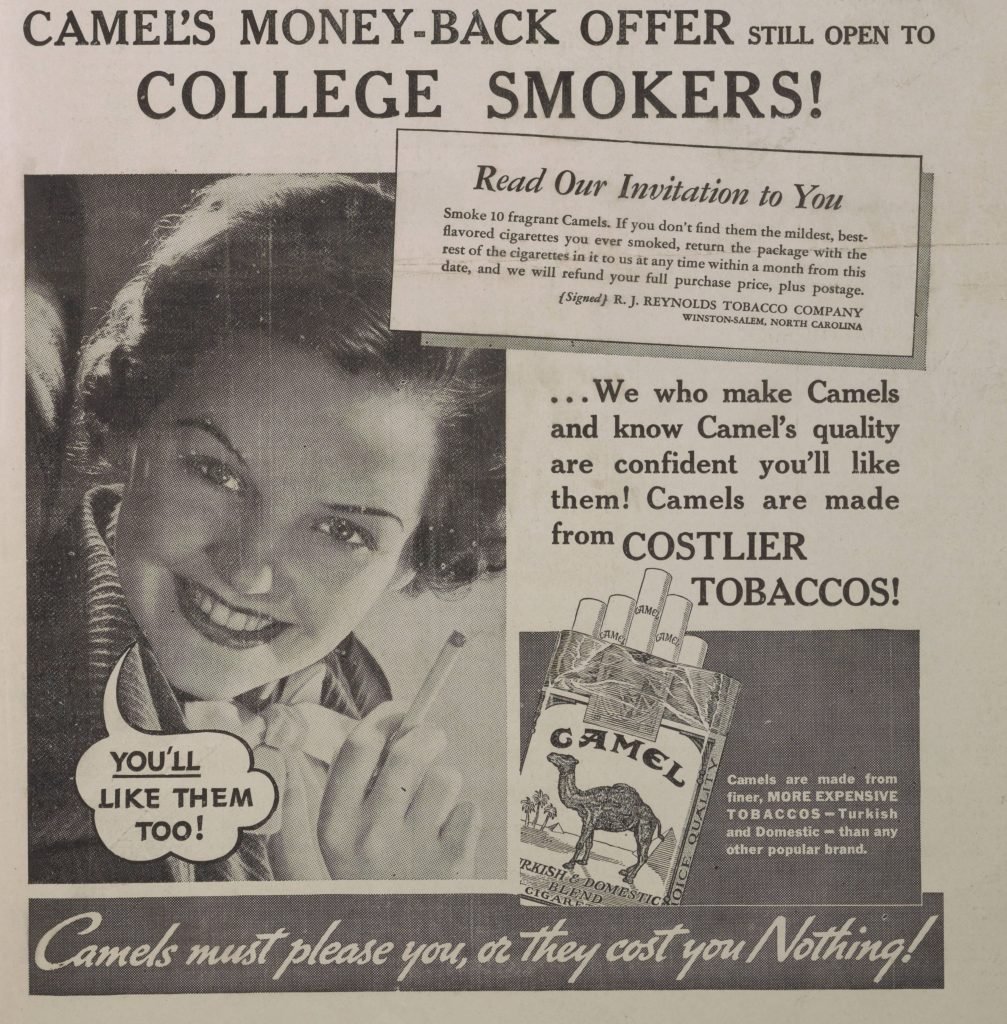
Needless to say, the tobacco industry enjoyed enormous revenues, which they dedicated to advertising. By the early 20th century, they had the best artists, designers, poster-boy politicians, actors, and athletes to promote their products.
The tobacco companies also convinced repressed groups that their product represented freedom and independence. Massive campaigns convinced women and society that smoking symbolized elegance, feminism, and independence. Women could smoke their cigarettes with style and “stick it to their husbands“!
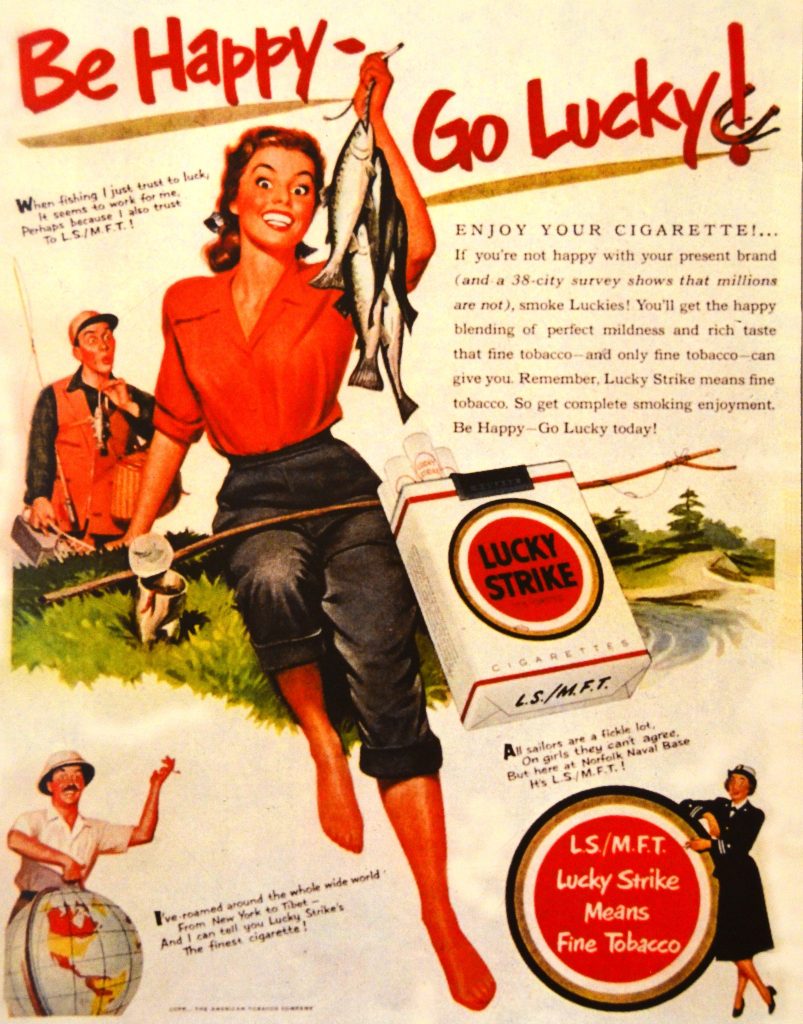
The tobacco industry reached a new campaign peak when they realized they could use medical doctors in their advertising. Showing the well-perceived, trusting, and intelligent doctors with a cigarette in familiar or scientific contexts anchored cigarettes to trust.
Historian of medicine Allan Brandt, who authored the book The Cigarette Century, nicely described the tobacco industry’s tactics in a 2012 review:
“The industry took a product that had existed at the cultural periphery and remade it into one of the most popular, successful, and widely used items of the early 20th century.”
As you can see, times were good for the tobacco industry. Still, what goes up must come down.
Problems in paradise
Our protagonist’s smooth, nearly obstacle-free successes eventually had to halt.
The public had become increasingly concerned about the health effects of smoking by the mid-1920s. Until that point, concerns about smoking had been raised but had only been associated with isolated cases of rare cancers. The cases of lung cancer started spiking, and people started noticing the correlation to cigarette consumption.
Accumulating studies identified a range of harmful substances in cigarettes, including carcinogens such as tar, arsenic, chromium, and nickel.
To rub salt in the tobacco industry’s wound, British psychologist Richard Doll entered the stage. Doll’s research in the late 40s confirmed a causal relationship between smoking and lung cancer. Over the years, he published several studies supporting this connection, including the landmark prospective British Doctors Study published in 1954 that followed the health outcomes of more than 40,000 doctors over 50 years. The study convincingly demonstrated the connection between tobacco smoking and lung cancer risk.
The tobacco industry was in a state of crisis. The trust the US tobacco industry had built for itself had started collapsing. They could say farewell to the momentum they’d gained from the joint efforts of John Wayne, Ronald Reagan, Frank Sinatra, and that lab-coat-wearing, smiling doctor smoking Luckys.
However, tough times required tough decisions, and the tobacco industry would show the world it meant business.
The Hotel Plaza meeting
Until this point, the tobacco industry had perfected the engineering of public consent through campaigns and promotions. Now, these companies realized that if public relations could manipulate consumer consent, it sure as hell could manipulate its arch-nemesis: the highly esteemed science.
In December 1953, the CEOs of the world’s six most powerful tobacco companies, including R.J. Reynolds, Philip Morris, and American Tobacco, met at Hotel Plaza in New York to plan and strategize their response to the mounting scientific evidence against smoking. Public relations would be their true and trusted strategy. However, in times of crisis and distrust, they needed to refine their approach.
John W. Hill was known for successfully managing corporate crises, especially those involving complex public controversies. The then-president of the leading PR firm Hill & Knowlton, now hired by the tobacco companies, was to become the mastermind behind the tobacco industry’s strategies to regain public trust.
For Hill, advertising alone was insufficient to convince the public. Instead, he planned to engineer public consent and uncertainty behind the scenes by skillfully managing the media. But more on the media later.
Instead of outright rejecting the scientific findings and consensus—which would reek of self-interest—the tobacco companies would continuously call for more research. As long as there was ‘more to investigate,’ the science would remain ‘unsettled’ in the eyes of the public.
By demanding more research, the companies used one of science’s core principles against the scientific consensus: skepticism. One of Hill’s first steps involved leaning into skepticism to create doubt—against science itself. Consequently, the tobacco industry invested in massive campaigns to convince the public that the smoking/cancer topic consisted of two sides of a controversial debate.
Today, we may recognize the tobacco industry’s tactics too well. However, at the time of the Hotel Plaza meeting, many of their strategies were groundbreaking.
The tobacco industry, with the expertise of Hill & Knowlton, hired scientists—often smokers—critical of the causal relationship between smoking and cancer. With a panel of so-called skeptical scientists, they gathered statements critical of the causal relationship between smoking and cancer. These statements helped the PR firm to create a stable basis for the campaigns that were to come.
Introducing industry-sponsored research
Today, companies fund universities left and right without raising many eyebrows. However, in the 1950s, funding from the private sector to independent researchers was relatively uncommon and often met with skepticism. The tobacco companies took the first baby steps toward social acceptance in science.
Still, merely giving money to science through large, controlling entities like the National Institute of Health (NIH), would limit the industry’s abilities to shape public opinion. Instead, Hill proposed partnering with university scientists, creating tighter bonds, considering the money went directly to scientists.
With a scientific panel and generous funding, the tobacco companies could declare their commitment to science and a shared concern for public health while hiding any self-interest. At the same time, their call for more research suggested that the current knowledge was insufficient and unfinished.
TIRC: A Trojan Horse for Doubt
“The TIRC marks one of the most intensive efforts by an industry to derail independent science in modern history.” —Allan Brandt.
Although the conditions to regain public trust were well orchestrated, the tobacco industry needed to formalize its scientific authority and cement its side of the narrative. Hill & Knowlton’s next secret weapon, the Tobacco Industry Research Committee (TIRC), served as a seemingly independent research body to create the illusion of unbiased scientific inquiry while generating confusion.
The introduction of TIRC resulted in the now infamous advertisement “A Frank Statement to Cigarette Smokers,” which they published in over 400 newspapers. The Frank Statement portrayed the tobacco companies as concerned corporate citizens, pledging to investigate the health risks of smoking for the sake of public safety.
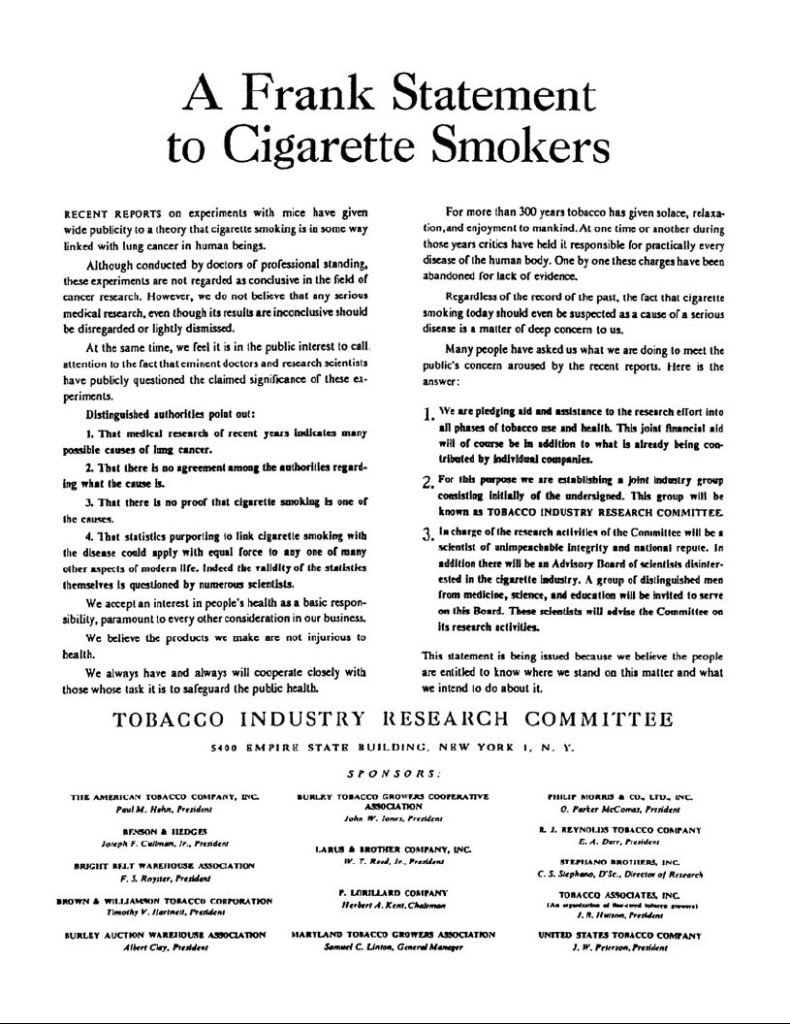
However, behind the scenes, the ad was a calculated move to buy time.
Under Hill’s guidance, the TIRC would produce a constant stream of research to control the narrative rather than finding the truth. Their goal wasn’t to answer critical scientific questions about any links between cigarettes and diseases, which risked exposing anti-smoking support. Instead, they delayed the public’s understanding of the health risks of smoking by conducting broad research.
The Scientific Advisory Board
Anyone in biotech or pharmaceutical companies is familiar with the Scientific Advisory Board (SAB). In short, a scientific advisory board contains a panel of experts who guide scientific research, policies, or technical matters to an organization or company.
We can thank Hill & Knowlton for the emergence of this type of node connecting industry and academic researchers.
The TIRC’s advisory board included carefully hand-picked scientists who would never directly investigate or propose research into the relationships between smoking and cancer. As described above, the TIRC programs disguised their true aims to highlight their interest in fundamental research, including genetics, immunology, and pharmacology.
This approach convinced the selected researchers that they were independent partakers in groundbreaking science. However, behind the scenes, the tobacco companies continuously manipulated the SAB to redirect funds from research on the effects of tobacco to more general questions.
Manufacturing consent
It’s worth re-emphasizing that the scientific consensus, by the 50s and 60s, already agreed that smoking caused several diseases and posed a risk to individuals and public health. Still, despite this, the tobacco industry could convince the public that the issue was “an active and highly contested scientific controversy.”
However, shouldn’t the scientific consensus be a strong enough argument? It should. But it’s not.
A crucial part of Hill & Knowlton’s campaign included convincing the media of the controversial nature of the tobacco topic. As a result, Hill committed much of his PR strategy to meet with representatives of media outlets.
Whenever the TIRC published a press release, the PR company would personally contact media outlets and request them to balance their reported views. That meant treating the TIRC’s press releases similar to the evidence-supported research. Hill & Knowlton required their small group of skeptics to receive the same importance or attention as the scientific consensus.
This strategy enticed journalists who saw their chance to report a controversial topic and simultaneously highlighted their balanced reporting—as if the findings were equally reliable. Since few journalists had scientific training during this period, these “controversial” claims were presented to the public as credible expert opinions.
On top of that, the tobacco company and the TIRC had access to scientific informants who’d notify the TIRC whenever new evidence against tobacco appeared. Sometimes, the TIRC would even have rebuttals ready before the scientific reports were published.
The lobby
This begs the question, is the modern tobacco lobby related to TIRC or SAB?
Well, kind of. In 1958, the tobacco industry created the Tobacco Institute, a powerful lobbying organization designed to influence political and regulatory landscapes aggressively. By the 1960s, as SAB scientists’ concerns about their independence and reputations grew, the tobacco industry realized it needed to further decouple its financial interests from its scientific arm—the TIRC and SAB. This separation allowed scientists to maintain their supposed objectivity while the industry intensified efforts to push harmful products and confuse the public about the health risks of smoking.
With Hill’s help, the tobacco industry had manipulated the narrative enough to create some breathing room.
*******
This is how a joint effort between the biggest US-based tobacco companies and a committed PR firm managed to flip the script during one of the industry’s most challenging times. They created an Aikido-like strategy, taking advantage of the opponent’s force.
By leaning into the curiosity, truth-seeking uncertainty ingrained in science and investing massive money in the process, the industry could hijack the scientific discourse and create doubt about their harmful products.
Meanwhile, other parts of the private sector learned how to manipulate the discourse—scientific or not—to dupe the public or delay any profits-averse tendencies. This event has guided large businesses worldwide to regain any threatened reputation. It taught Big Pharma, Big Agriculture, and other influential voices associated with science how to influence and tighten their relationships with other businesses, universities, decision-makers, and media outlets.
Academic and tax-funded research is especially vulnerable to the presence of corporate research since the latter blurs the line between public and financial interests. With conflicts of interest becoming increasingly common and challenging to track, the public may ultimately choose the easiest, most available way to deal with science: skepticism and distrust.
And although the tobacco industry’s original tactics may have shifted, it maintains its reputation-serving efforts. Rather than retreating, the industry has adapted and changed course to navigate modern regulatory landscapes and public health campaigns. Today, Big Tobacco finds new ways to influence public perception and delay action, whether through lobbying, funding research, or rebranding its products to appear safer. The strategy remains the same—sow doubt, deflect accountability, and protect profits.
And then we wonder why people stopped trusting scientists…
Watch the video here:


