

If open-access publishing is supposed to democratize science, why are editors resigning en masse from open-access journals, citing unethical practices?
In a conversation with Fancy Comma’s Sheeva Azma, which you can find on our YouTube and blog, we discussed the anti-trust class action lawsuit against six large academic publishers. The plaintiff claims that the publishers don’t compensate scholars for their services, avoid competition by requiring authors to publish in one journal at a time, and restrict researchers from sharing their findings during the reviewing process.
Scientists have long known the publishing industry has exploited the goodwill of researchers and the public’s curiosity for science. We’ve often hidden behind a nervous smile, accepting these conditions due to an ingrained “Publish or Perish” mentality, which forces researchers to run the hamster wheel, chasing new publications—unconditionally.
We’ve reminded ourselves that we need this system to publish more and land high-impact articles, and we’ve followed it up with a self-reassuring “Well, it is what it is. Don’t panic; keep publishing.”
Most academic publishers are private for-profit enterprises dominating the scholarly publishing landscape and report large profit margins—typically around 40%, which is higher than other industries. They reap the fruits of primarily tax-funded research and a free workforce from research institutions. Many journals charge high prices for subscriptions or individual articles, restricting science access to the few who can afford it. Publishers even own the results, requiring authors to transfer copyright through exclusive publishing agreements.
It’s a rooted relationship covered by contradictions and lack of transparency, ultimately slowing scientific advancements. (You can read about a similar relationship between science and the tobacco business here.)
But, scientists have started taking action against the publication system.
Mass resignations from publishers
In the past few decades, we’ve seen an upsurge in the actions for a fairer and more open distribution of scientific knowledge. These actions involve lawsuits, free community-driven preprint repositories like arXiv or bioRxiv, and mass resignations from academic journals.

The rise of the open-access movement was a purposeful reaction to these conditions, aiming to democratize scientific knowledge. Open-access journals have emerged as increasingly popular options since the 90s due to their free access to scientific knowledge. As the name suggests, open-access journals make scientific content more accessible to the readers, for example, by avoiding paywalls.
Large academic publishers, such as Elsevier and Springer Nature, eventually adapted to the rising trend—although initially resisting it—and started offering open-access journals by the early 2010s. Part of the reasons for their changed approach included public and academic pressure and the potential for maintaining market relevance.
During our conversation, Sheeva highlighted a case in which the editorial board of Elsevier’s open-access journal NeuroImage decided to resign jointly to start their own open-access journal. Similar initiatives have gained traction in the last decade, often in response to unfair pricing strategies.
What started as a good intention to democratize science is failing to learn from some of the mistakes of academic publishing. In other words, editors are leaving the very system that was supposed to open science. What’s going on?
Open access: open to readers, not authors
To understand why editors leave open-access journals, we should familiarize ourselves with the open-access business models.
Many resigning editors claim they leave because of the publishers’ unethical nature and “excessively high article-processing charges (APCs) set by the publishers“—sometimes ranging from $3,850 to $11,690, which becomes extra problematic for poorer labs. You see, if the readers don’t pay for the articles, someone else must cover the expenses (and revenues).
Open-access journals primarily apply one of four sub-models to maintain scientific articles accessible to the reader:
- Gold: Authors pay APCs to ensure free access for readers.
- Green: Authors archive a free, non-peer-reviewed version of their manuscript in public repositories like arXiv or bioRxiv.
- Hybrid: Subscription-based journals allow authors to pay APCs to make individual articles freely accessible.
- Bronze: Articles are temporarily free but later restricted, lacking a long-term open-access license.
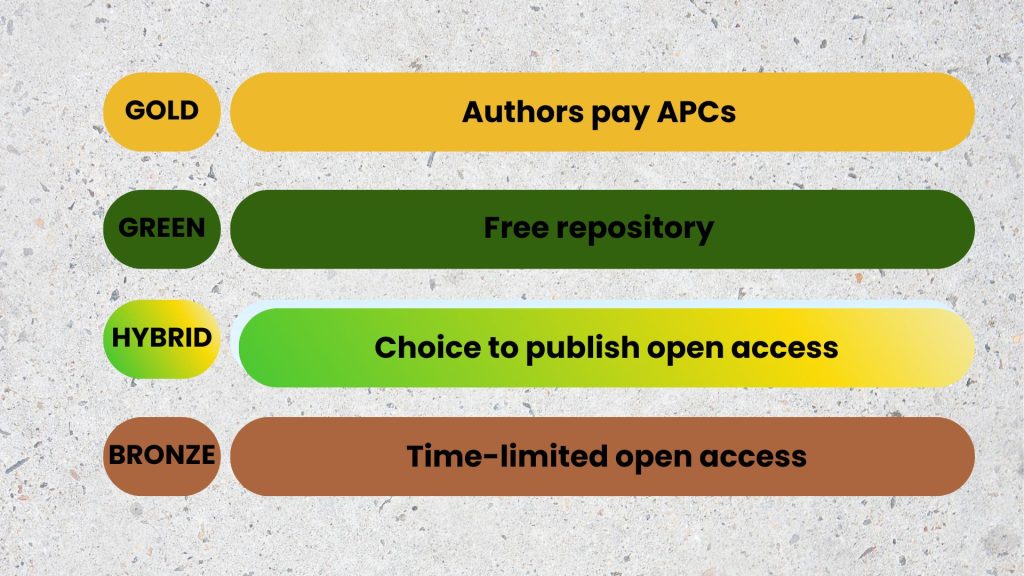
Gold is easily the most common of these sub-models, constituting 38% of all scholarly content in 2023. The strength of this model is that it reliably offers free access to research articles. The weakness is that it requires the authors’ financial contributions.
Regardless of how much publishers follow the trends for democratizing science, for-profit publishers will try to collect their profit.
This brings us back to the latest mass resignations, including editors at Elsevier’s Neuroimage and other publishers. Open-access journals charge different APCs depending on the journal’s size, volume of manuscripts sent for review, and impact factors. However, the resigning editors at Neuroimage argue that “the fees don’t reflect direct article costs,” condemning the publishers’ possibility of profiting from science they haven’t funded.
A solution to ‘excessively high APCs’
It’s easy to believe the editors in the current mass resignations oppose open access, considering they leave in protest. However, these mass resignations reflect the priority contradictions between for-profit publishers and journals on the one hand and authors and the public on the other.
“You have publishers—most of them are for-profit—that demand and require constant growth because that’s what the stock market requires. You have researchers, academics or editors, for the most part, who champion quality and maybe depth and time to review,” co-founder of Retraction Watch, Ivan Oransky, told Nature.
Mass resignations like these open up new alternatives to tackle these contradictions. Many resigning editors have started alternative non-profit channels, which they can control better.
Editors who’ve resigned to protest excessive APCs have founded more affordable and ethical publishing models. Some have chosen to lower the authors’ APCs. Others approached it slightly differently by implementing a diamond open-access model where neither the authors nor readers pay for the articles. Most of these journals belong to universities, other academic institutions, public communities, government agencies, or individuals.
The publishing process has long been a contentious topic in academic environments. Most researchers have felt powerless to change a now-rooted publication system, which research depends on but primarily benefits for-profit publishers.
As researchers, we scoffed at the publication system but ultimately shrugged our shoulders, lowered our heads, and continued our business as usual. Editors and other academics are now taking steps towards improving the authors’ conditions and accessibility of articles to benefit science and the public instead of shareholders.


